
LiteSpeed Hosting is a web hosting service that uses LiteSpeed Web Server, a high-performance web server developed by LiteSpeed Technologies. Unlike traditional Apache, LiteSpeed uses an event-driven architecture to handle thousands of concurrent connections while consuming significantly fewer resources.
This article explains how LiteSpeed Web Server works, compares it directly with Apache and Nginx across key criteria, and helps you evaluate whether LiteSpeed hosting is right for your website.
What is LiteSpeed Web Server?
LiteSpeed Web Server (LSWS) is a commercial web server software running on Linux, developed by LiteSpeed Technologies since 2003. The core difference between LSWS and Apache lies in the processing architecture: instead of creating a separate process for each connection like Apache, LiteSpeed uses an event-driven model, allowing a single process to handle thousands of connections simultaneously.
LSWS is designed as a drop-in replacement for Apache. This means LSWS can directly read Apache configuration files, support .htaccess, mod_rewrite and mod_security without any modifications. Switching from Apache to LiteSpeed on a server typically takes about 15 minutes with zero downtime.
Currently LiteSpeed has three main editions:
- OpenLiteSpeed: The open-source, free edition, suitable for personal websites or developers who want to manage their own server.
- LiteSpeed Standard: Free, supports control panels (cPanel, DirectAdmin), suitable for small websites with low traffic.
- LiteSpeed Enterprise: The full-featured commercial edition, widely used by hosting providers. Supports unlimited domains with deep cPanel and DirectAdmin integration.
How does LiteSpeed work?
At the core of LiteSpeed is its event-driven architecture. To illustrate: Apache is like a restaurant that opens a separate serving station for each customer, requiring more stations and staff as customers increase. LiteSpeed is like a modern bar where one bartender can serve many customers simultaneously without needing additional staff.
Specifically, LiteSpeed handles PHP through the LSAPI (LiteSpeed Server Application Programming Interface) protocol, optimized specifically for communication between the web server and PHP. Compared to PHP-FPM used by Nginx and Apache, LSAPI reduces overhead in PHP process management, especially under high server load.
Another important strength is that LiteSpeed is fully compatible with the Apache ecosystem: .htaccess files work normally, mod_rewrite and mod_security rules don’t need to be rewritten. This is why LiteSpeed integrates well with popular control panels like cPanel, Plesk and DirectAdmin, while Nginx doesn’t support .htaccess and requires separate configuration.
LiteSpeed vs Apache vs Nginx comparison
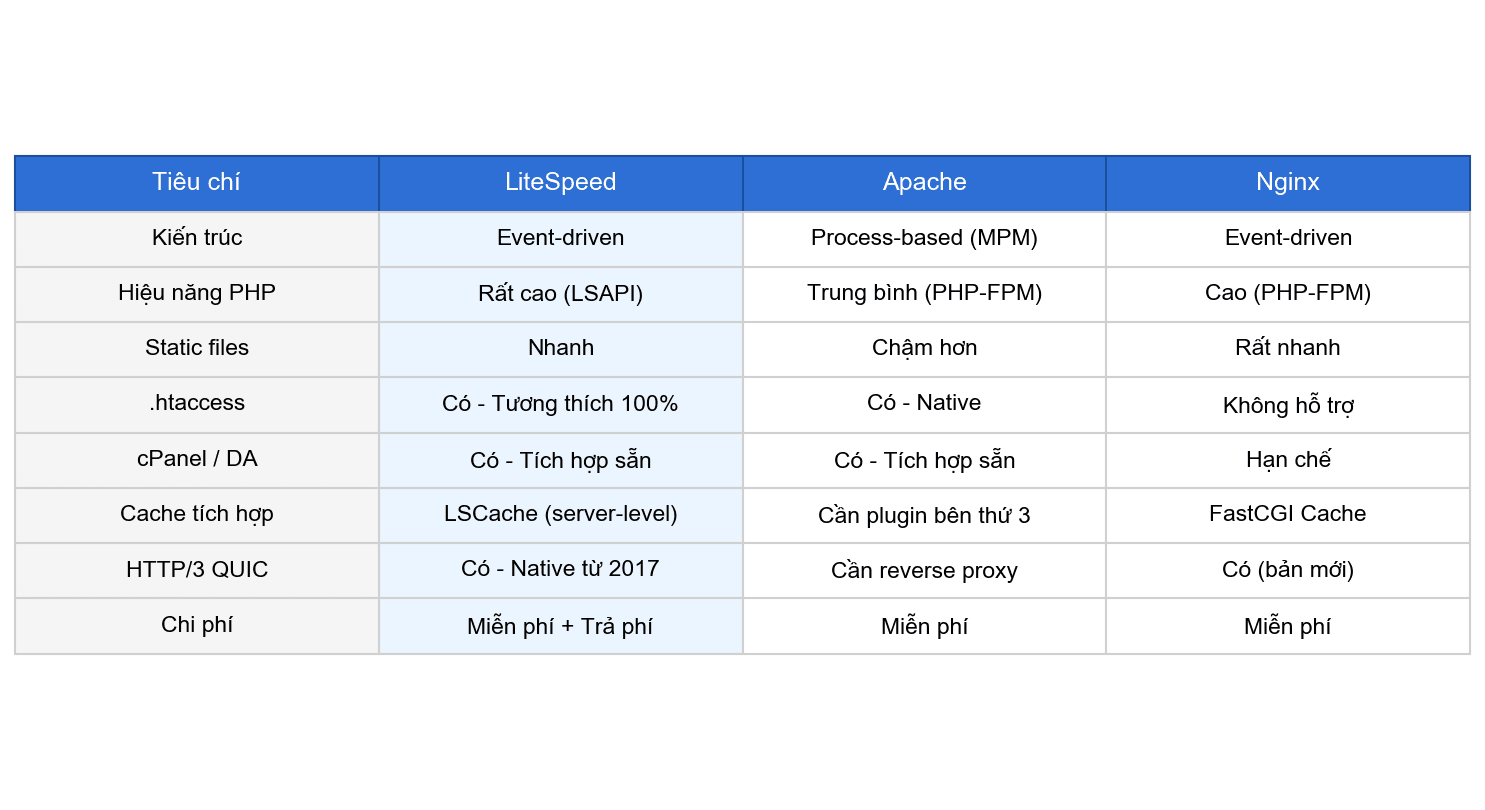
These three web servers serve different needs. Below is a detailed analysis by each criterion.
PHP processing performance
LiteSpeed uses LSAPI, a protocol specifically designed to optimize communication between the web server and PHP. In WordPress benchmarks, LiteSpeed can handle approximately 5,100 requests per second with caching enabled, more than 2x Nginx (about 2,200 req/s) and 5x Apache (about 900 req/s).
Without caching (uncached PHP), the gap narrows. LiteSpeed and Nginx produce nearly identical results, while Apache is about 20-30% slower due to overhead from the process-based model.
Static files
For static files (images, CSS, JavaScript), Nginx has a slight edge (about 5-10%) over LiteSpeed for small files. Apache trails both by about 15-25%. However, for larger files (50KB and above), the difference between Nginx and LiteSpeed is negligible.
Built-in caching
This is LiteSpeed’s greatest strength. LSCache (LiteSpeed Cache) operates at the server level, not at the PHP level like regular cache plugins. When a page is cached, LiteSpeed serves the result directly without invoking PHP or the database, reducing TTFB (Time to First Byte) to milliseconds.
Nginx has FastCGI Cache which is also quite powerful, but requires manual configuration and lacks smart purge mechanisms for WordPress. Apache relies almost entirely on third-party cache plugins like WP Super Cache or W3 Total Cache, which operate at the PHP level and are therefore slower.
.htaccess and control panel compatibility
LiteSpeed and Apache both support .htaccess, an important factor for shared hosting as it allows each hosting account to configure redirects, URL rewrites, and directory security without server config access. Nginx doesn’t support .htaccess; all changes must be made in Nginx configuration files with service restarts.
For this reason, LiteSpeed and Apache integrate well with cPanel and DirectAdmin, while Nginx requires additional configuration.
HTTP/3 and QUIC
LiteSpeed was the first web server to support QUIC (since 2017) and HTTP/3 at production level. HTTP/3 uses the QUIC protocol instead of TCP, reducing connection establishment latency and improving performance on unstable mobile networks. Learn more about BBR features in LiteSpeed QUIC and HTTP/3.
Nginx supports HTTP/3 in newer builds, but the implementation is not as optimized as LiteSpeed’s. Apache currently doesn’t support HTTP/3 natively and requires a front reverse proxy.
Security
All three support mod_security rules. LiteSpeed adds built-in brute-force protection, server-level reCAPTCHA, and connection/bandwidth throttling mechanisms against DDoS. Apache has a rich security module ecosystem but requires more manual configuration. Nginx excels at rate limiting and reverse proxy filtering.
Real-world benchmarks
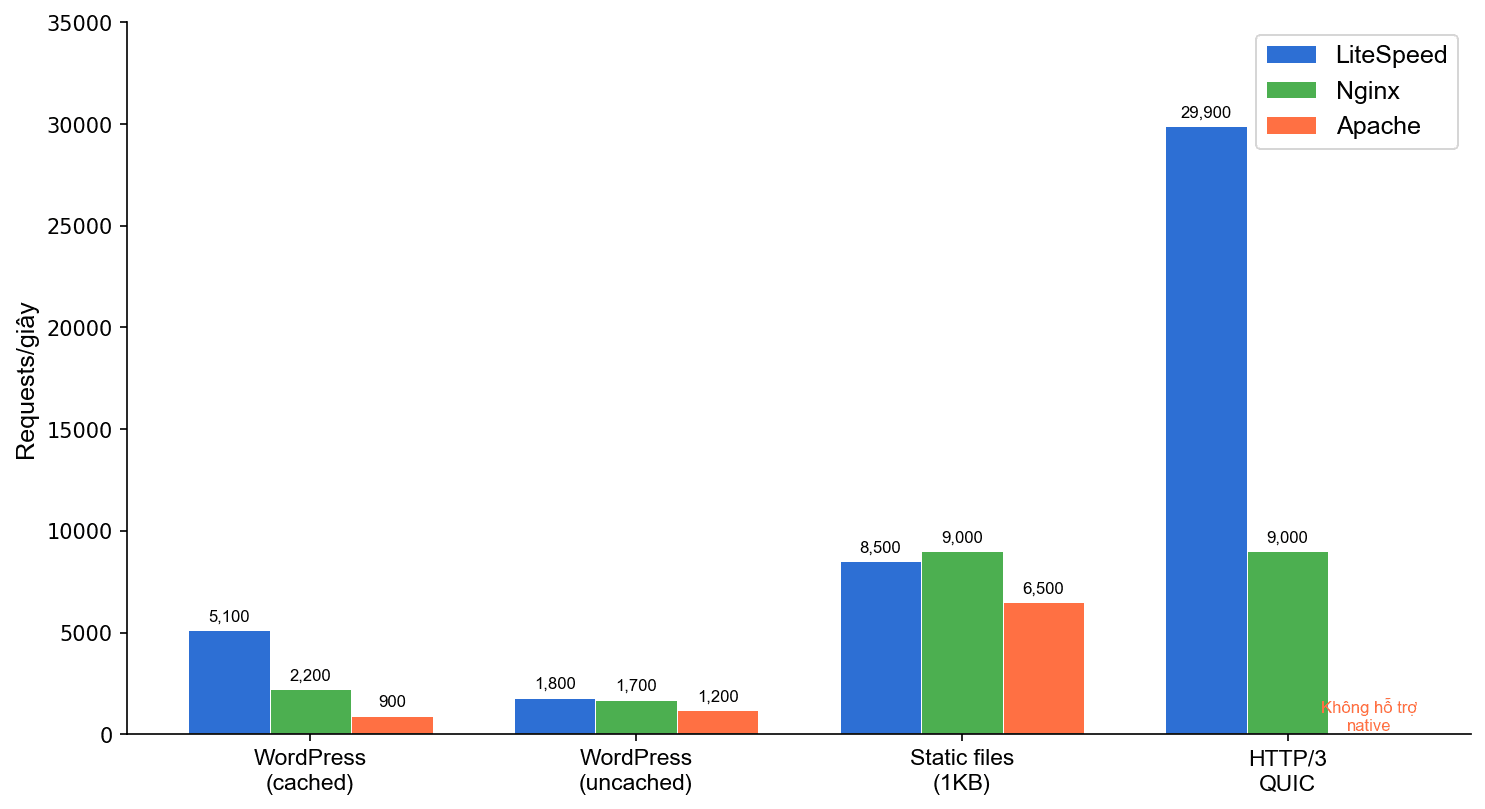
Based on independent benchmarks from multiple sources, results show:
- WordPress cached: LiteSpeed + LSCache leads clearly. On the same 4 vCPU, 8GB RAM, NVMe SSD configuration, LiteSpeed achieves about 5,100 req/s vs Nginx FastCGI Cache (~2,200 req/s) and Apache + Varnish (~1,500 req/s).
- WordPress uncached: LiteSpeed (LSAPI) and Nginx (tuned PHP-FPM) produce nearly identical results; Apache is about 20-30% slower.
- TTFB: With caching enabled, LiteSpeed typically delivers the most stable TTFB, especially during traffic spikes.
A real-world test on a standard WordPress website showed: Apache loaded pages in about 3.5 seconds, Nginx about 2.1 seconds, and LiteSpeed about 1.2 seconds. When LSCache was additionally enabled, load times decreased even further.
LiteSpeed Cache for WordPress
LiteSpeed Cache for WordPress (LSCWP) is a free, open-source plugin with over 6 million installations on WordPress.org. This plugin directly leverages the cache engine built into LiteSpeed Web Server, delivering performance that pure PHP cache plugins cannot match. See also the complete guide to configuring LiteSpeed Cache for WordPress on AZDIGI hosting.
Key features of LSCWP:
- Server-level full-page cache: Pages are cached and served directly from the web server, bypassing PHP and the database.
- Edge Side Includes (ESI): Allows full-page caching while keeping dynamic sections (WooCommerce cart, logged-in user info) fresh.
- Image Optimization: Automatically compresses and converts images to WebP via QUIC.cloud.
- Object Cache: Supports Redis and Memcached for caching database queries.
- CSS/JS Optimization: Minify, combine and lazy load CSS/JavaScript.
- Browser Cache: Configure browser-side caching.
- Database Optimization: Clean up revisions, transients, spam comments.
- CDN Integration: Supports QUIC.cloud CDN and third-party CDNs.
Important note: LSCWP delivers maximum performance when running on LiteSpeed Web Server. If you use Nginx or Apache, the plugin still works but only optimization features (image, CSS/JS, database) are available; the server-level caching won’t be functional.
LiteSpeed hosting in Vietnam
In Vietnam, many hosting providers have adopted LiteSpeed Enterprise for their shared hosting infrastructure:
- AZDIGI: All hosting plans (from Pro Platinum Hosting to Turbo Business) use LiteSpeed Enterprise combined with NVMe RAID-10, Redis Cache, Imunify360 and CloudLinux. Datacenters located in Ho Chi Minh City (FPT IDC Tan Thuan and Viettel IDC Song Than), 10Gbps network.
- Vietnix: Uses LiteSpeed Enterprise on hosting and WordPress Hosting plans, combined with SSD/NVMe.
- TinoHost, Mat Bao, P.A Vietnam: Have also deployed LiteSpeed on some hosting plans.
The general trend is that Vietnamese hosting providers are gradually transitioning from pure Apache to LiteSpeed, especially for WordPress and WooCommerce hosting plans.
5 reasons to choose LiteSpeed hosting
1. Noticeably faster page load speeds
With event-driven architecture and LSAPI, LiteSpeed hosting processes PHP 2-5x faster than Apache. When combined with LSCache, speed can improve up to 10x compared to Apache hosting without caching. This is also why website speed is considered a factor that directly affects SEO and user experience.
2. Server resource savings
LiteSpeed consumes less CPU and RAM than Apache when handling the same traffic volume. On shared hosting, this means your website is less affected by other websites on the same server.
3. Free and powerful LSCache
The LiteSpeed Cache plugin for WordPress is completely free, featuring full caching capabilities, image optimization, CSS/JS optimization that many paid plugins offer. Running on a LiteSpeed server, LSCache delivers superior performance compared to WP Rocket or W3 Total Cache.
4. Native HTTP/3 and QUIC
LiteSpeed has supported HTTP/3 and QUIC since very early on. These two technologies help reduce connection establishment time, particularly beneficial for mobile users or unstable networks.
5. Full Apache compatibility
If your website is currently running on Apache, switching to LiteSpeed requires virtually no changes. .htaccess files, mod_rewrite, and mod_security all work normally. You can also check out 6 top WordPress speed optimization mistakes to avoid for further optimization.
AZDIGI and LiteSpeed Enterprise
All of AZDIGI’s hosting infrastructure uses LiteSpeed Enterprise, the highest-tier commercial edition. Specifically:
- Servers use Intel Xeon Platinum 3.9GHz and AMD EPYC CPUs, combined with NVMe Enterprise RAID-10 storage delivering thousands of MB/s read/write speeds.
- LSCache is pre-activated on all hosting plans, combined with Redis Object Cache to optimize database queries.
- HTTP/3 QUIC, Brotli compression, Imunify360 security and CloudLinux for resource isolation between accounts are all supported.
- 2 datacenters in Ho Chi Minh City (FPT IDC Tan Thuan and Viettel IDC Song Than), ensuring low latency for Vietnamese users.
If you’re looking for affordable hosting with LiteSpeed, AZDIGI’s Pro Hosting plans start from 29,000 VND/month. For higher requirements, Pro Platinum Hosting uses NVMe and Platinum CPUs starting from 55,000 VND/month. You can also view the hosting pricing table for detailed plan comparisons.
Conclusion
LiteSpeed Web Server delivers superior performance compared to Apache in most workloads, especially with WordPress and WooCommerce thanks to the integrated LSCache. Compared to Nginx, LiteSpeed matches processing speed but gains an advantage through .htaccess compatibility and a smarter cache engine.
If your website runs WordPress and you care about page load speed, LiteSpeed hosting is a sensible choice. Combined with the free LiteSpeed Cache plugin, you can achieve high PageSpeed scores without complex configuration.
To learn more about hosting types, check out What is Hosting? Essential web hosting knowledge. Also see top hosting in Vietnam to compare reputable providers.
You might also like
- Top 5 best budget hosting in Vietnam 2026: detailed comparison & benchmarks
- AZDIGI vs Hawk Host: configuration, speed, and real-world performance comparison
- What is Business Hosting? Guide to Choosing the Right Plan
- How to enable LiteSpeed Cache on Hosting at AZDIGI
- NVMe Hosting vs SSD Hosting: A Detailed Performance Comparison
- What is cPanel Reseller Hosting Service?
About the author

Trần Thắng
Expert at AZDIGI with years of experience in web hosting and system administration.