
According to updated information from LiteSpeed’s homepage, currently, software versions, including LiteSpeed Webserver 5.4.2, Web ADC 2.6.0 and OpenLiteSpeed 1.6.1, have integrated algorithmic technology to control congestion. BBR (Bottleneck Bandwidth and Round-trip propagation time). But few people know their benefits and features. Let’s learn with AZDIGI the features of the BBR algorithm on LiteSpeed Webserver.

Congestion control for LiteSpeed QUIC and HTTP/3
BBR (Bottleneck Bandwidth and Round-trip propagation time) is a congestion control algorithm developed at Google. This algorithm can be used in computers, phones, and even tablets, provided that there is an Internet connection.
In the TCP protocol, BBR promises better congestion control and can also be used in the QUIC (Quick UDP Internet Connections) protocol that is being used on AZDIGI Hosting services when using HTTPS.
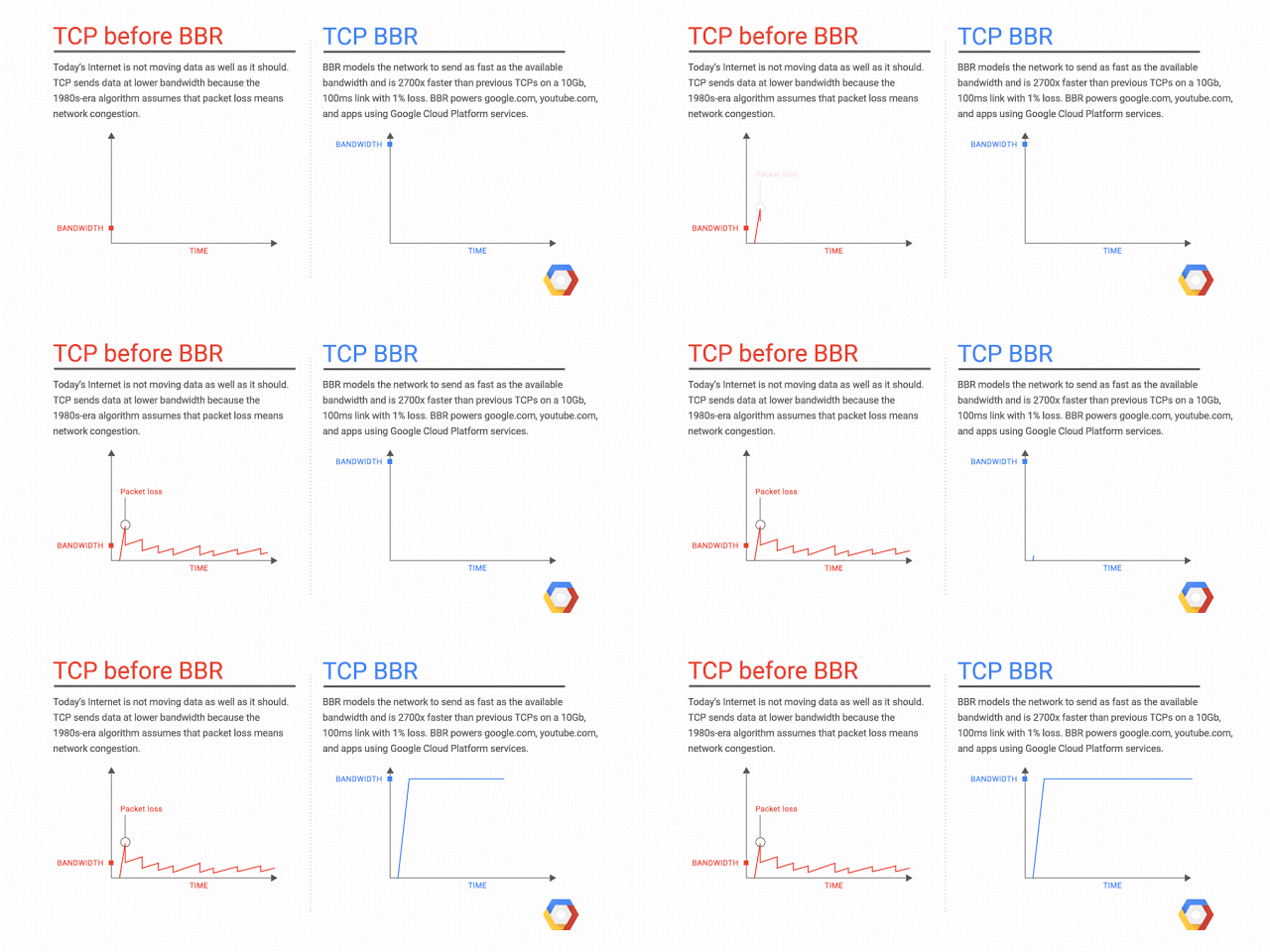
BBR is now implemented in Linux kernels above 4.9. However, it has been shown to require careful tweaking in interactions.
Outstanding features of BBR
1. Anti-packet loss.
In the data transfer process, we may encounter some risks, such as data packets being blocked or packet loss due to radio interference. Now the BBC is based on a congestion algorithm that helps to distinguish between fake losses and true congestion. Thereby helping to maintain the transmission speed to avoid congestion or data loss during transmission.
It can be seen that BBR can provide a sustainable performance even when faced with suboptimal network conditions.
2. Reduce latency to a minimum
BBR helps to monitor congested bandwidth, periodically checking in minimum round-trip time. This monitoring and calculation help to limit the situation of “Bottleneck”.
Besides the advantages, BBR also exposes certain limitations, such as performing poorly on shallow buffers on the path and may not be fair for other flows. In addition, there is a major limitation of BBR that it only works on most of the available bandwidth.
However, according to a Google source, these issues will be resolved in BBR v2 – A new version is being researched and developed.
Summary
Compared to the Cubic congestion control algorithm, BBR is a fairly new congestion control tool with two great advantages: minimizing data loss and low latency. With LiteSpeed, BBR can be leveraged to power servers, Google QUIC and HTTP/3 connections.
If you want to know more about the difference between BBR and Cubic algorithms, you can refer here.
At AZDIGI, all Hosting service packages use LiteSpeed Webserver Enterprise with the latest version updated daily, so that customers always have the best experience. Through AZDIGI’s measurement, the page load will be about 20% – 30% faster when the BBR algorithm is enabled on Hosting servers.
Therefore, AZDIGI has used BBR features on all services with LiteSpeed integration to bring the best effect in customer experience.
You might also like
- Enable QUIC (HTTP/3) on OpenLitespeed
- What is LiteSpeed Hosting? Performance comparison with Apache and Nginx
- HTTP/3 speeds up websites when using the HTTPS protocol
- AZDIGI Tools User Guide - Free DNS, Network, SSL Checker Toolkit
- TLS 1.3 – Improve performance, comprehensive security for Hosting
- AZDIGI vs Hawk Host: configuration, speed, and real-world performance comparison
About the author

Thạch Phạm
Đồng sáng lập và Giám đốc điều hành của AZDIGI. Có hơn 15 năm kinh nghiệm trong phổ biến kiến thức liên quan đến WordPress tại thachpham.com, phát triển website và phát triển hệ thống.