
Zimbra used to be a familiar name to many users when they needed a suitable solution for email and collaboration. But when costs, licensing methods, or operational complexity started to change, finding a reasonable replacement has also become a very practical need.
With articles like this, what matters is not just listing tool names. Readers usually want to know which solution better fits their needs: need a comprehensive toolset, need easy self-hosting, need serious production deployment, or should go with a service approach to reduce operational burden.
Quick Overview Table
| Tool | Suitable for | Main Strength | Things to Note |
|---|---|---|---|
| iRedMail | administrators who want to build a fairly complete mail server | deploy fairly comprehensive mail server | operating mail servers still requires experience |
| mailcow | teams wanting to self-host modern mail stack with Docker | fairly modern admin interface | requires resources and understanding mail stack operations |
| Modoboa | people needing a more compact open source email management platform | fairly clear domain/mailbox management | smaller ecosystem than popular names |
| Stalwart Mail Server | people wanting modern and high-performance mail server | newer architecture | market familiarity not as high as older solutions |
When to Look for Zimbra Alternatives
With Zimbra, the question is usually not just “is there any tool that can replace it”, but “replace it with what to fit the team and current operations”. There are solutions suitable for those who want a fairly complete mail stack, but there are also more suitable choices if you prioritize simplicity or more modern architecture.
iRedMail
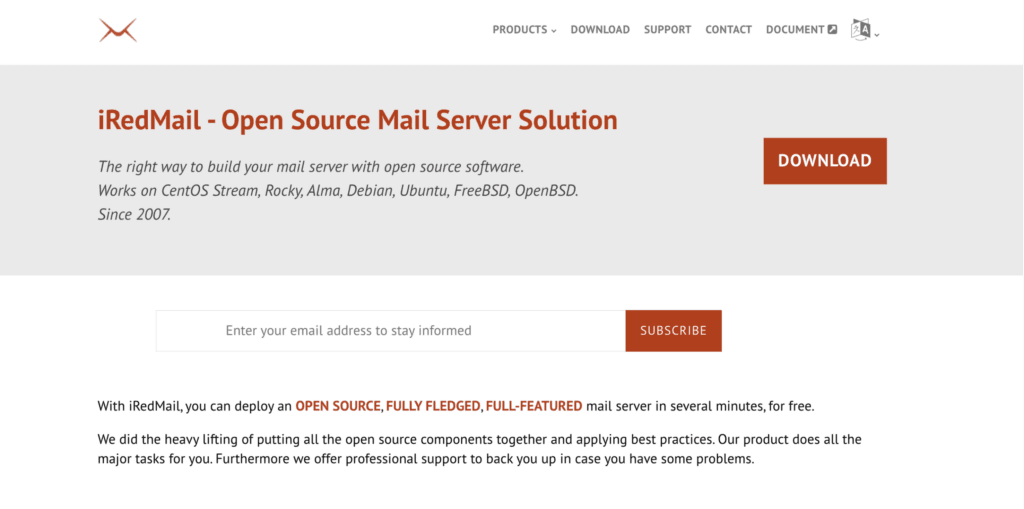
iRedMail is suitable for those who want a relatively complete mail server from the start, instead of having to assemble too many separate components. The notable point about iRedMail is that it bundles quite a few important parts of the mail stack into a relatively clear deployment approach, so it is often mentioned when someone needs a more serious self-host solution than basic lab level.
In practice, iRedMail fits administrators or technical teams who accept self-operating mail servers and understand that this is not the type of service to “install and forget”. If businesses still want to control their email systems but do not want to start from zero, iRedMail is a quite reasonable starting point.
The point to consider is the operational cost in terms of effort. Getting it running is just the first step; the hard part lies in updates, anti-spam, monitoring deliverability and handling long-term incidents. Therefore, iRedMail fits those who accept the operational challenge, not groups that only need an email service to “use immediately and be done”.
mailcow

mailcow is often noticed by many people because of its modern approach and easier visualization compared to some traditional mail stacks. If you want to self-host email but still like clear deployment models, lean toward Docker and have an admin interface that is easy to follow, mailcow is a name very worth checking out.
mailcow’s strength lies in its more “productized” feel. It suits technical teams who want a sufficiently modern solution for lab, testing and even running small to medium production if they have appropriate operational capabilities. Compared to overly manual approaches, mailcow gives a more approachable feel for people already familiar with containerization.
However, do not let the clean interface make you think this is a light problem. Mail server is still mail server: needs resources, needs correct DNS configuration, and needs careful monitoring of security and reputation. mailcow fits people who accept serious self-hosting, not people who just want to avoid licensing fees at any cost.
Modoboa
Modoboa is suitable for those who want a more compact open source email management platform, easier to grasp and not too heavy like a big suite. The notable point about Modoboa is that the domain management, mailbox and basic tasks parts are quite clear, so it is easily shortlisted when users need a self-host email solution but do not want an overly complex stack.
In practice, Modoboa fits better with groups needing a just-enough system, with clear management characteristics, and not necessarily having to embrace too many complex collaboration components. It is not the loudest name in the market, but quite suitable for people who like a compact solution with a relatively practical approach.
The point to consider is that the popularity level and ecosystem are not as thick as some other choices. That means when encountering difficult cases, community documentation and shared experience might be less. Therefore, Modoboa fits people who know what they need, rather than those who want to choose the most popular solution to avoid having to think.
Stalwart Mail Server

Stalwart Mail Server is quite an interesting name if you are looking at the mail server market from a newer technology angle. Compared to many solutions familiar for a long time, Stalwart is attractive in its modern architecture, performance-oriented and feeling built for today’s operational requirements instead of just extending an old model.
Stalwart’s strength lies in opening up a direction worth considering for those who do not want to follow exactly the path of traditional mail stacks. If the technical team likes to try a newer solution, more compact in architecture and ready to dive deep, this is a name worth examining carefully.
However, Stalwart does not yet have the market familiarity level of longer-standing choices. That means if you prioritize a strong community, lots of practical documentation and many production cases that have been widely verified, you will have to consider more carefully before choosing it as the main solution.
Which Tool to Choose
- iRedMail: suitable for administrators wanting to build a fairly complete mail server
- mailcow: suitable for teams wanting to self-host modern mail stack with Docker
- Modoboa: suitable for people needing a more compact open source email management platform
- Stalwart Mail Server: suitable for people wanting modern and high-performance mail server
- If you need a more complete mail stack, prioritize choices with clear ecosystem and mail components.
- If you need easier self-hosting for lab or testing, choose tools with strong community and clear deployment methods.
- If you need serious production, prioritize solutions that the team can operate long-term, not just get running.
- If you do not want to self-operate mail servers, you can consider going the service route like Email Hosting or Email Server depending on business model.
In cases where businesses do not want to handle all the mail server, anti-spam, backup and deliverability problems themselves, going the service route is still a more practical choice. When needing to control infrastructure for deployment or separate internal systems that come with it, AMD Cloud Server is a more suitable direction than forcing everything into a self-managed mail stack.
You might also like
- 4 Free and Open-Source Coolify Alternatives for Self-Hosting Applications
- 4 Free and Open-Source Alternatives to Cloudflare Tunnel Worth Considering
- Comparison: Google Workspace, Microsoft 365, Zoho Workplace, Proton for Business, and Fastmail
- What is Flowise? When Should You Self-Host It on a VPS?
- Umbrella chart vs microservices strategy: When should you use each one? (Part 11/12)
- What is vLLM? When should you use vLLM instead of Ollama
About the author

Trần Thắng
Expert at AZDIGI with years of experience in web hosting and system administration.